
Pre-project planning is the stage where you decide how a project should run, before the site gets busy and expensive surprises begin. Risk management fits here because most problems do not start on Day 1. They start with an unclear scope, missing approvals, weak coordination, or wrong assumptions.
If you handle risks early, you protect time, budget, people, and quality. SFV Services works across project development from concept to completion, so the planning phase is treated as a serious working stage, not a quick checklist. You bring your goals, limits, and timelines. The team helps turn that into a plan with fewer gaps, fewer last-minute changes, and better control.
Start With a Clear Project Definition
A risk plan cannot work if the project itself is fuzzy. Start by writing down what success looks like. Keep it simple, but specific enough that everyone reads the same meaning.
Include items like:
- The purpose of the build and the expected outcome
- Key spaces, functions, or operational needs
- Must-have dates and any move-in limits
- Budget range and what it includes
- Who makes decisions, and who approves changes
This is also where you confirm how you will communicate. If the client and the project team do not agree on basic items, risks will show up as delays, change orders, and conflict. A practical approach is to set a routine for short check-ins and clear sign-offs, so people do not assume the same thing.
Build a Risk Register That Feels Real
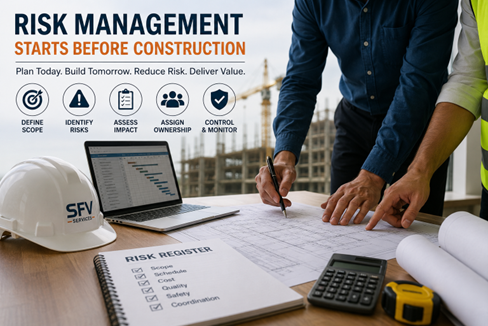
A risk register is just a written list of risks, but it must reflect real project conditions under the commercial pre-construction services. Keep it simple enough to manage, but broad enough to cover common risk areas.
Add risks under headings like:
- Scope and design gaps
- Cost and procurement
- Schedule and phasing
- Site access and safety
- Trade coordination and staffing
- Quality control and rework
For each risk, write three things: what can happen, why it may happen, and what early sign you should watch. Then assign an owner. If nobody owns a risk, it gets ignored until it becomes a fire.
Rank Risks Using a Simple Method
You do not need complex scoring to make this useful. Use two basic factors: likelihood and impact. Then decide what deserves action now.
A simple ranking approach:
- High likelihood + High impact = Act early
- High likelihood + Low impact = Monitor and control
- Low likelihood + High impact = Create backup plans
- Low likelihood + Low impact = Note it, do not overwork it
This keeps attention on what can damage the project the most. It also prevents the team from spending days on low-value risks while big issues stay open.
Match Risks to the Project Delivery Plan
Risk management must fit the way the project is being managed. A project that involves multiple locations, ongoing facility needs, or retail rollout work will carry different risks than a single one-off build. SFV Services has experience across General Contracting, Construction Management, New Construction, Facilities Management, and Retail and Franchise Services, which matters because risk patterns change across these settings.
Plan around items like:
- Long-lead materials and early purchasing needs
- Working hours, access rules, and site limits
- Phasing needs to keep operations running
- Consistent standards across locations
- Vendor coordination and supply timing
When the delivery plan is realistic, risk controls become easier to apply. When it is not, the schedule becomes a wish list, and the risk plan turns into damage control.
What are the Pre-Construction Services?
If you are confused about what are the pre-construction services? They are the planning and coordination steps taken before construction begins, meant to set scope, schedule, cost, and responsibilities in a way that reduces confusion later. Commercial pre-construction services include early reviews of drawings, budgets, schedules, site requirements, and coordination plans so the project starts with fewer open questions and fewer hidden risks.
Create a Table For Risk Actions and Ownership
A table helps the team see who does what, and when. It also keeps the risk register from feeling abstract.
| Risk area | Common risk | Early warning sign | Who owns it | Early control step |
| Scope | Missing scope items | Repeated clarifying questions | Project lead | Confirm written scope and sign-off |
| Schedule | Long-lead delays | Vendor lead times not confirmed | Procurement lead | Lock lead times and order early |
| Cost | Budget creep | Frequent changes in requirements | Client decision owner | Change control with quick approvals |
| Site | Access restrictions | Conflicts with operations | Site coordinator | Access plan and work-hour plan |
| Coordination | Trade overlap | Clashes in sequencing | Construction manager | Coordination plan and weekly look-ahead |
| Quality | Rework | Field questions increase | QA lead | Clear standards and inspections |
This table should be reviewed often in planning, then updated once construction begins. Risks shift as details become final.
Plan Communication to Prevent Small Risks From Growing
A lot of risk is really a communication failure. People assume, delay responses, or avoid hard conversations. That is when minor issues turn into change orders and schedule hits. SFV Services focuses on trust, transparency, and open communication, which is not a soft idea. It is a practical control method.
Set clear rules such as:
- One place for the latest documents and decisions
- A fixed time for weekly coordination calls
- A simple method for logging decisions
- A clear path for urgent issues
- A short response expectation for approvals
When communication is consistent, risks show up earlier. Early problems are cheaper problems.
Add Change Control Before Changes Start Arriving
Change is normal in construction. The risk is not changing itself. The risk is unmanaged change. Your plan should include how changes are requested, reviewed, approved, and priced.
A workable approach:
- Write what counts as a change
- Require a short written change request
- Review the schedule and cost impact together
- Approve in writing before work starts
- Track approved changes in one log
This keeps the project fair. It also protects relationships, because people can point to a process instead of blaming each other.
Conclusion
Risk management does not end once the project begins. It becomes a weekly habit. Review the top risks often, update the register, and confirm that owners are doing the early control steps. SFV Services takes a collaborative approach and stays available to discuss challenges, which matters because risks change as work progresses.
When the team treats risk work as normal project work, you avoid panic decisions and rushed fixes. The result is a project that feels calmer, clearer, and easier to manage, even when issues show up. That is what strong pre-project planning is meant to deliver.